
 English
 Indonesian
 简体字
简体字
 العربية
 Español
 Français
 Português
 日本語
日本語
 한국어
한국어
 Tiếng Việt
Sign In to Continue
To view and access the document, you are required to sign in to your account first.
Don't have an account? Sign Up Here
Home How Myristic Acid Is Sourced: From Palm Kernel Oil to Global Markets
Supply Chain | 27 April 2026
How Myristic Acid Is Sourced: From Palm Kernel Oil to Global Markets
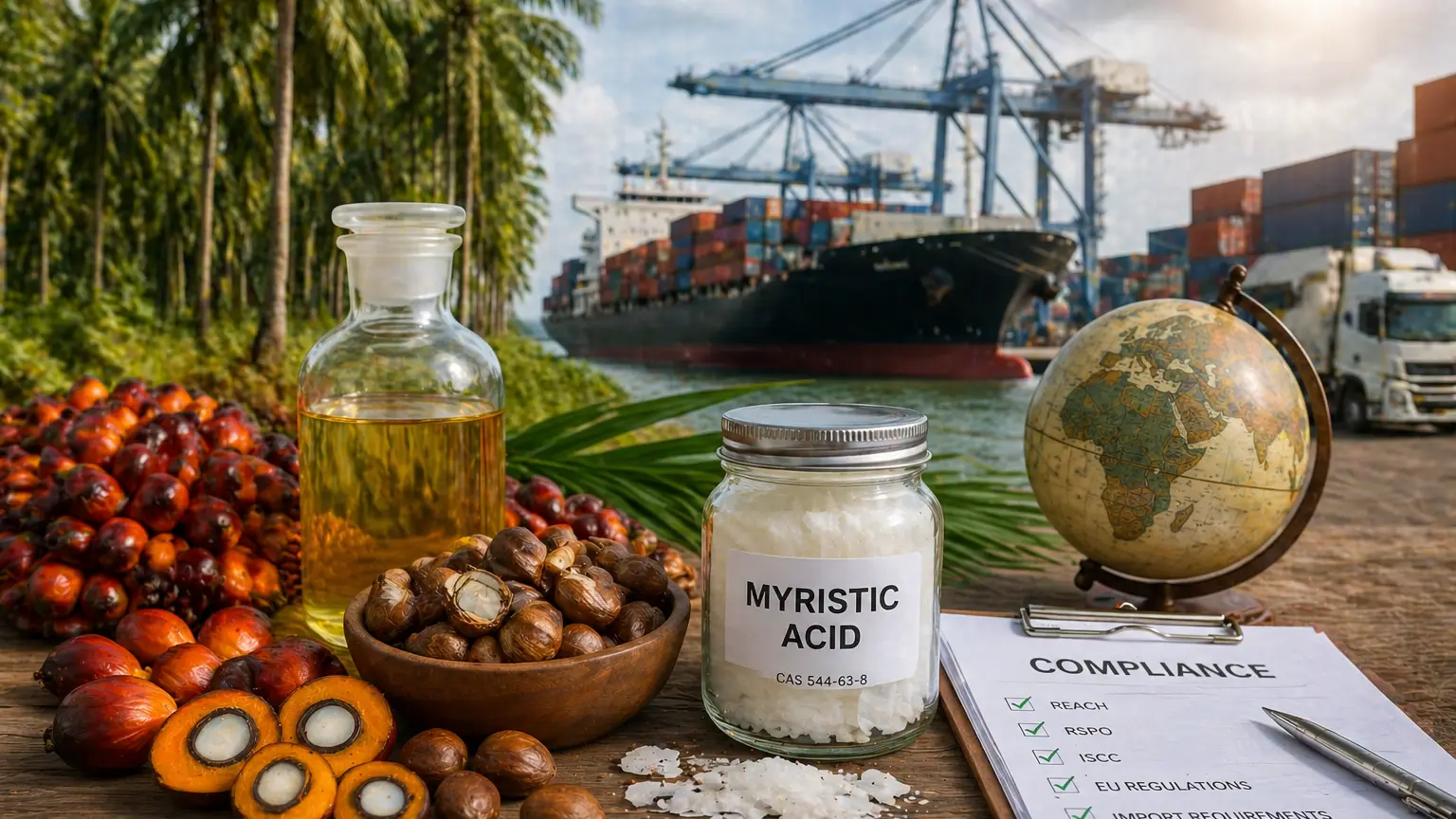
Table of Content
-
Introduction
-
What Is Myristic Acid and Why Is It Important?
-
The Primary Source: Palm Kernel Oil and Its Processing
-
The Global Supply Chain for Myristic Acid
-
Key Applications and Benefits of Myristic Acid
-
Market Trends and Data Insights
-
Conclusion
Introduction
The global chemical industry relies heavily on a steady and high-quality supply of fatty acids, among which Myristic Acid stands out as a critical component for numerous industrial and consumer applications. As a saturated fatty acid with a 14-carbon chain, it is a fundamental building block in the production of soaps, cosmetics, lubricants, and surfactants. Understanding how Myristic Acid is sourced, from its natural origins to its arrival in global markets, is essential for procurement managers, formulators, and business strategists alike.
This comprehensive article delves into the journey of Myristic Acid, beginning with its primary source—palm kernel oil. We will explore the extraction and refining processes, the intricate global supply chain, and the key applications that drive demand. By providing real-world data and market insights, this guide aims to equip readers with a thorough understanding of the Myristic Acid market, highlighting the importance of reliable sourcing and supply chain transparency for businesses worldwide.
What Is Myristic Acid and Why Is It Important?
Myristic Acid, also known as tetradecanoic acid, is a common saturated fatty acid found naturally in many animal fats and vegetable oils, with the highest concentrations found in nutmeg butter, coconut oil, and particularly palm kernel oil. Its chemical formula is CH₃(CH₂)₁₂COOH. In its pure form, it appears as a white or yellowish solid with a faint, characteristic odor. The significance of Myristic Acid in the global chemical market cannot be overstated; it is a versatile intermediate used across multiple industries.
The importance of this fatty acid stems from its unique chemical properties, including its ability to act as a surfactant and emulsifier. In the personal care industry, it is a key ingredient in the production of soaps and detergents because it produces a rich, stable lather and contributes to a hard, long-lasting bar. Furthermore, its derivatives are used in the formulation of shaving creams, shampoos, and cosmetic creams to improve texture and consistency. The industrial sector also relies on Myristic Acid for manufacturing rubber, plastics, and lubricating greases, where it serves as a release agent or a stabilizer.
From a market perspective, the demand for Myristic Acid is closely tied to the production of palm kernel oil and the overall health of the oleochemical industry. As consumer preference shifts toward natural and plant-based ingredients, the role of Myristic Acid derived from sustainable sources has become even more critical. This makes understanding its sourcing and supply chain a strategic priority for companies aiming to secure high-quality raw materials for their manufacturing processes.
The Primary Source: Palm Kernel Oil and Its Processing
The primary and most commercially viable source of Myristic Acid is palm kernel oil, which is extracted from the kernel of the oil palm fruit (Elaeis guineensis). Unlike palm oil, which is derived from the fleshy mesocarp of the fruit, palm kernel oil is obtained from the inner seed or kernel. This distinction is crucial because the fatty acid profiles of the two oils differ significantly. Palm kernel oil is exceptionally rich in lauric acid (C12) and myristic acid (C14), typically containing between 14% and 18% Myristic Acid. This high concentration makes it the most efficient and cost-effective feedstock for myristic acid production.
The journey from palm kernel to Myristic Acid involves a sophisticated multi-stage process. Initially, the palm kernels are cleaned, cracked, and pressed to extract the crude palm kernel oil. This crude oil then undergoes a refining process that includes degumming, neutralization, bleaching, and deodorization to remove impurities, free fatty acids, and color bodies. The refined palm kernel oil is then subjected to a process called splitting, where it is reacted with water under high pressure and temperature to break down the triglycerides into free fatty acids and glycerol.
Following splitting, the mixed fatty acids are separated through a process known as fractional distillation. This is the most critical step for isolating Myristic Acid. Using a series of distillation columns under vacuum, the different fatty acids are separated based on their boiling points. Myristic Acid is collected as a specific fraction, achieving purities of 95% to 99% or higher depending on the application. The final product is then flaked, prilled, or pastillated for easy handling and transportation. This entire process, from kernel to high-purity Myristic Acid, requires significant capital investment and technical expertise, making the choice of supplier a key decision for downstream users.
The Global Supply Chain for Myristic Acid
The global supply chain for Myristic Acid is a complex network that begins with palm oil plantations, primarily located in Southeast Asia. Indonesia and Malaysia are the world's largest producers of palm kernel oil, accounting for over 85% of global production. From these origins, the crude palm kernel oil is either processed locally into Myristic Acid or exported to oleochemical refineries in other regions, including Europe, North America, and China. This geographical concentration makes the supply chain sensitive to regional factors such as weather patterns, agricultural policies, and geopolitical stability.
Key players in this supply chain include integrated palm oil companies, specialized oleochemical manufacturers, and global chemical distributors. Companies like TradeAsia play a vital role by bridging the gap between producers and end-users. They manage logistics, quality assurance, and inventory to ensure a consistent supply of Myristic Acid to customers around the world. The supply chain is further complicated by the need for sustainable sourcing certifications, such as the Roundtable on Sustainable Palm Oil (RSPO), which is increasingly demanded by downstream consumers in the cosmetics and food industries.
Logistics and transportation are critical components of the Myristic Acid supply chain. The product is typically shipped in solid form (flakes or pastilles) in bags, supersacks, or in bulk via specialized containers. Maintaining product integrity during transit is essential to prevent contamination or moisture absorption. A robust supply chain also requires strategic warehousing and inventory management to buffer against supply disruptions. For buyers, understanding this chain—from the plantation to the distributor—is essential for risk management and for ensuring the traceability and quality of the Myristic Acid they procure.
Key Applications and Benefits of Myristic Acid
Myristic Acid is a highly versatile chemical with a wide range of applications, each leveraging its unique physical and chemical properties. One of its most prominent uses is in the manufacture of personal care and cosmetic products. In soap making, Myristic Acid is prized for its ability to create a creamy, stable lather with excellent cleansing properties. It also contributes to the hardness of soap bars, making them more durable. In skin creams and lotions, it acts as an emollient and thickening agent, helping to stabilize emulsions and provide a smooth, non-greasy feel on the skin.
Beyond personal care, Myristic Acid has significant industrial applications. It is used as a raw material for the production of myristate esters, which serve as plasticizers, lubricants, and textile auxiliaries. In the rubber industry, it is employed as an activator and dispersing agent. The metalworking sector uses its derivatives as corrosion inhibitors and lubricating additives. The benefits of using Myristic Acid in these applications include improved product performance, enhanced stability, and a natural, biodegradable profile that meets growing environmental regulations.
From a product specification standpoint, commercial Myristic Acid is available in various grades to suit different applications. Standard industrial grades typically have a purity of 95-98%, while higher purity grades (99%+) are used for premium cosmetics and pharmaceutical applications. Key specifications include acid value, saponification value, iodine value, and melting point. For example, a typical Myristic Acid product might have an acid value of 244-248 mg KOH/g and a melting point of 52-54°C. Understanding these specifications is crucial for formulators to ensure the final product meets its intended performance criteria. The use of high-quality Myristic Acid directly translates to better batch-to-batch consistency and superior end-product quality.
Market Trends and Data Insights
The global market for Myristic Acid is experiencing steady growth, driven by increasing demand from the personal care, cosmetics, and industrial sectors. According to recent market research, the global fatty acids market, of which Myristic Acid is a key segment, is projected to grow at a compound annual growth rate (CAGR) of 4-6% over the next five years. This growth is fueled by rising disposable incomes in developing economies, which is boosting consumption of personal care products, and a growing preference for natural and bio-based ingredients in industrial formulations.
A significant trend shaping the Myristic Acid market is the increasing emphasis on sustainability and traceability. Consumers and regulatory bodies are demanding greater transparency in the supply chain, particularly concerning palm oil derivatives. This has led to a rise in the availability of RSPO-certified Myristic Acid and a push for mass balance or segregated supply chains. Companies that can offer certified sustainable Myristic Acid are gaining a competitive advantage, especially in the European and North American markets where environmental, social, and governance (ESG) criteria are becoming procurement prerequisites.
Another important market insight is the volatility of raw material prices. The cost of Myristic Acid is directly linked to the price of palm kernel oil, which is influenced by global vegetable oil markets, weather conditions, and energy costs. This price volatility makes long-term supply agreements and strategic partnerships with reliable distributors like TradeAsia invaluable. By working with a partner that has deep market knowledge and robust inventory management, buyers can mitigate price risks and ensure a stable supply of Myristic Acid for their production needs, regardless of short-term market fluctuations.
Conclusion
The journey of Myristic Acid from the palm kernel to a finished product on the global market is a testament to the sophistication of modern oleochemistry. Its sourcing, deeply rooted in the agricultural and industrial processes of Southeast Asia, feeds a complex supply chain that delivers this essential ingredient to industries worldwide. From producing a luxurious lather in a bar of soap to stabilizing high-performance industrial lubricants, Myristic Acid is an indispensable chemical raw material. Understanding its origins, processing, and market dynamics is crucial for any professional involved in its procurement or application.
As the market continues to evolve with a focus on sustainability, quality, and supply chain resilience, the role of knowledgeable and reliable partners becomes increasingly important. Whether you are a formulator seeking high-purity Myristic Acid for a new cosmetic line or a procurement manager looking to secure a long-term supply, having a deep understanding of the entire value chain is a strategic asset. The future of the Myristic Acid market will be shaped by innovation in processing, sustainable sourcing practices, and the ability to adapt to shifting global demand.
Disclaimer: This article is provided for informational and market insight purposes only. It is not intended to serve as technical, safety, or professional advice regarding the handling, application, or procurement of Myristic Acid. Readers are strongly advised to independently verify all information with qualified experts, consult official documentation such as Material Safety Data Sheets (MSDS/SDS), and contact our team for specific application guidance. The data and trends presented are based on publicly available information and market analysis at the time of writing and should not be solely relied upon for making business or operational decisions.
Tags
Most Popular Insights
Most Popular Insights
Don't miss out on our updates!
Subscribe to our newsletter now
We're committed to your privacy. Tradeasia uses the information you provide to us to contact you about our relevant content, products, and services. For more information, check out our privacy policy.