
 English
 Indonesian
 简体字
简体字
 العربية
 Español
 Français
 Português
 日本語
日本語
 한국어
한국어
 Tiếng Việt
Sign In to Continue
To view and access the document, you are required to sign in to your account first.
Don't have an account? Sign Up Here
Home Is Myristic Acid Safe? Global Compliance Standards Buyers Must Know
Regulatory and Compliance | 27 April 2026
Is Myristic Acid Safe? Global Compliance Standards Buyers Must Know
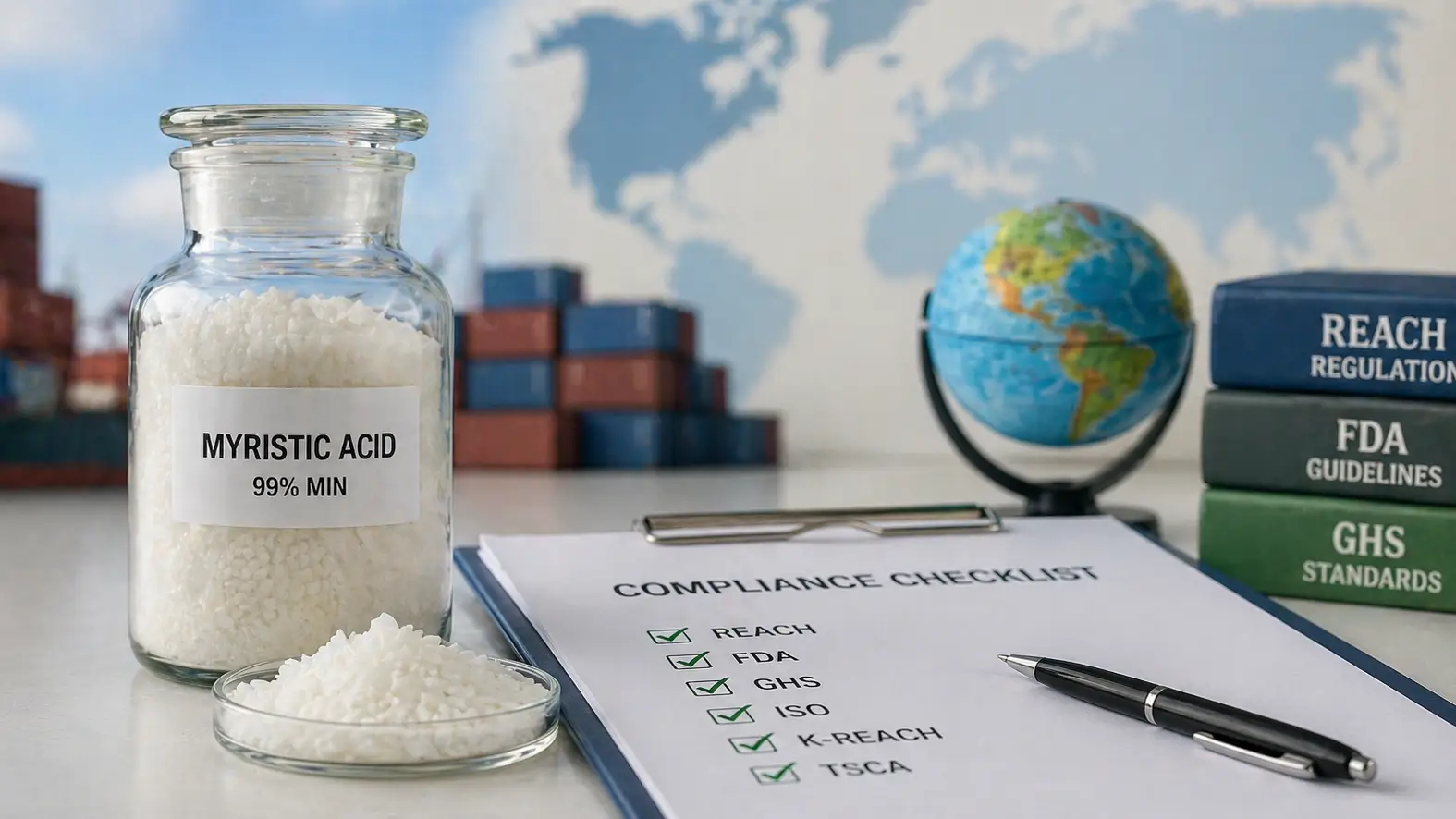
Table of Content
-
Introduction
-
Understanding Myristic Acid and Its Industrial Significance
-
Key Global Regulatory Frameworks for Myristic Acid
-
Safety Profile and Toxicological Data for Myristic Acid
-
Applications and Compliance Challenges in Key Industries
-
Best Practices for Sourcing Compliant Myristic Acid
-
Conclusion
Introduction
In the complex world of global chemical trade, ensuring the safety and regulatory compliance of raw materials is not just a best practice—it is a commercial necessity. For buyers and manufacturers utilizing fatty acids, one compound frequently comes under scrutiny: Myristic Acid. This saturated fatty acid, commonly derived from coconut oil and palm kernel oil, is a cornerstone ingredient in industries ranging from personal care to industrial lubricants. However, with varying international standards, a single question dominates procurement strategies: "Is Myristic Acid safe, and how do I ensure it meets global compliance?"
This article serves as a comprehensive guide for global buyers. We will dissect the regulatory landscape, examine safety data, and provide actionable insights for sourcing high-quality Myristic Acid. By understanding the standards set by bodies like the FDA, REACH, and CosIng, businesses can mitigate risk and ensure their supply chain is both legal and ethical. For detailed product specifications and sourcing inquiries, myristicacid.com offers a direct portal to verified suppliers and technical documentation.
Understanding Myristic Acid and Its Industrial Significance
Myristic Acid (CAS 544-63-8), also known as tetradecanoic acid, is a common saturated fatty acid with a 14-carbon chain. It is naturally present in many animal and vegetable fats, but commercial production predominantly relies on the hydrolysis and fractionation of coconut oil and palm kernel oil. Its physical form is typically a white or yellowish solid with a faint, characteristic odor. The global market for Myristic Acid has seen steady growth, driven by its indispensable role in surfactant production and emollient formulations.
From a market perspective, the demand for Myristic Acid is closely tied to the personal care and cosmetics industry, which accounts for over 60% of its consumption. It is a primary component in the synthesis of isopropyl myristate, a widely used emollient and solvent. Beyond cosmetics, it functions as a stabilizer in soap manufacturing, a lubricant in metalworking fluids, and a plasticizer in rubber production. Understanding these diverse applications is crucial for buyers because the required purity and compliance documentation vary significantly between a cosmetic grade and an industrial grade of Myristic Acid.
Key Global Regulatory Frameworks for Myristic Acid
Navigating the regulatory environment for Myristic Acid requires a multi-jurisdictional approach. In the European Union, the compound is regulated under the REACH (Registration, Evaluation, Authorisation and Restriction of Chemicals) regulation. It is listed as a registered substance, meaning manufacturers and importers must provide safety data and risk management measures. Furthermore, the CosIng database lists Myristic Acid as an approved cosmetic ingredient, with specific restrictions regarding its maximum concentration in leave-on products to prevent skin irritation.
In the United States, the Food and Drug Administration (FDA) oversees Myristic Acid under the Federal Food, Drug, and Cosmetic Act. It is generally recognized as safe (GRAS) for use as a direct food additive when used as a flavoring agent or adjuvant. The Cosmetic Ingredient Review (CIR) Expert Panel has also evaluated Myristic Acid and concluded it is safe for use in cosmetic products when formulated to be non-irritating. For buyers targeting the Asian markets, such as China and Japan, compliance with the Inventory of Existing Chemical Substances (IECSC) and the Japanese Chemical Substances Control Law (CSCL) is mandatory. This patchwork of regulations underscores the need for a supplier who can provide region-specific certificates of analysis (COAs) and safety data sheets (SDS).
Safety Profile and Toxicological Data for Myristic Acid
The safety of Myristic Acid is well-documented in scientific literature. Acute toxicity studies indicate that it has a low oral and dermal toxicity profile. The LD50 (lethal dose, 50%) for oral ingestion in rats is greater than 10,000 mg/kg, classifying it as practically non-toxic. However, like many fatty acids, it can be a mild irritant to the eyes and skin at high concentrations. The primary safety concern for formulators is not systemic toxicity but rather the potential for comedogenicity—meaning it can clog pores in some individuals when used in high concentrations in cosmetic products.
From a manufacturing and handling perspective, Myristic Acid is considered a combustible solid, not a flammable one. It poses a low fire risk but can burn if exposed to an ignition source. The most critical safety guideline involves avoiding the inhalation of dust or fumes during processing. Modern safety data sheets (SDS) for Myristic Acid emphasize the use of proper ventilation and personal protective equipment (PPE) such as safety goggles and gloves. For global buyers, ensuring that the supplier provides an up-to-date SDS compliant with the Globally Harmonized System (GHS) is a fundamental step in risk management.
Applications and Compliance Challenges in Key Industries
The application of Myristic Acid in the cosmetic industry presents the most stringent compliance challenges. It is used in soaps, shampoos, and skin creams as a cleansing agent and emulsifier. The challenge here is purity; cosmetic-grade Myristic Acid must have a high saponification value and be free from heavy metal contaminants like lead and arsenic. Buyers must request a heavy metals analysis (typically below 10 ppm for lead) to comply with global cosmetic regulations. For example, the EU Cosmetics Regulation (EC) No 1223/2009 requires that all ingredients be traceable and safe, placing the onus on the importer to verify these parameters.
In the industrial sector, Myristic Acid is used as a lubricant additive and in the production of rubber accelerators. Compliance here is less about human exposure and more about environmental impact and occupational safety. For instance, under the European Water Framework Directive, the discharge of fatty acids into waterways is monitored. Industrial buyers must ensure that their supplier's manufacturing process adheres to local environmental laws regarding waste treatment and effluent discharge. Furthermore, for food-grade applications, such as a flavoring agent, the Myristic Acid must comply with the Food Chemicals Codex (FCC) standards, which dictate specific purity and identity tests.
Best Practices for Sourcing Compliant Myristic Acid
To mitigate compliance risks, buyers should adopt a structured sourcing strategy. The first step is to request a comprehensive technical data package from the supplier. This package should include a Certificate of Analysis (COA) showing the acid value, iodine value, and melting point, as well as a detailed GHS-compliant Safety Data Sheet (SDS). For Myristic Acid intended for the European market, the supplier must provide a REACH registration number. For the US market, evidence of FDA compliance or a letter of guarantee is often required.
Secondly, buyers should consider the traceability of the raw material. Given that Myristic Acid is often derived from palm oil, sustainability certifications like RSPO (Roundtable on Sustainable Palm Oil) are becoming increasingly important for brand reputation. A supplier who can offer Mass Balance or Segregated RSPO-certified Myristic Acid provides a significant market advantage. Finally, it is wise to conduct a supplier audit or request samples for in-house testing. Verifying the chain of custody and the accuracy of the documentation is the only way to guarantee that the Myristic Acid you purchase will pass customs and regulatory checks in your target country. For reliable sourcing and detailed compliance documentation, myristicacid.com connects you with vetted global suppliers.
Conclusion
In conclusion, Myristic Acid is a safe and versatile compound when sourced and handled according to established global standards. Its low toxicity profile and broad industrial utility make it a staple ingredient, but compliance is not automatic. Buyers must navigate a complex web of regulations including REACH, FDA, and CosIng, and must verify purity, traceability, and documentation with every shipment. By prioritizing supplier transparency and requesting robust technical data, businesses can confidently utilize Myristic Acid in their products while maintaining full regulatory compliance.
Disclaimer: This article is provided for informational and market insight purposes only and is not intended as technical, safety, or professional regulatory advice. The information presented does not replace a thorough review of official documentation such as Safety Data Sheets (SDS) or Material Safety Data Sheets (MSDS), nor does it substitute for consultation with qualified toxicologists, regulatory affairs specialists, or legal counsel. Readers are strongly advised to independently verify all compliance requirements with relevant authorities and experts specific to their product application and target market. For specific application guidance or to request detailed compliance documentation for Myristic Acid, please contact our team directly through myristicacid.com.
Tags
Most Popular Insights
Most Popular Insights
Don't miss out on our updates!
Subscribe to our newsletter now
We're committed to your privacy. Tradeasia uses the information you provide to us to contact you about our relevant content, products, and services. For more information, check out our privacy policy.